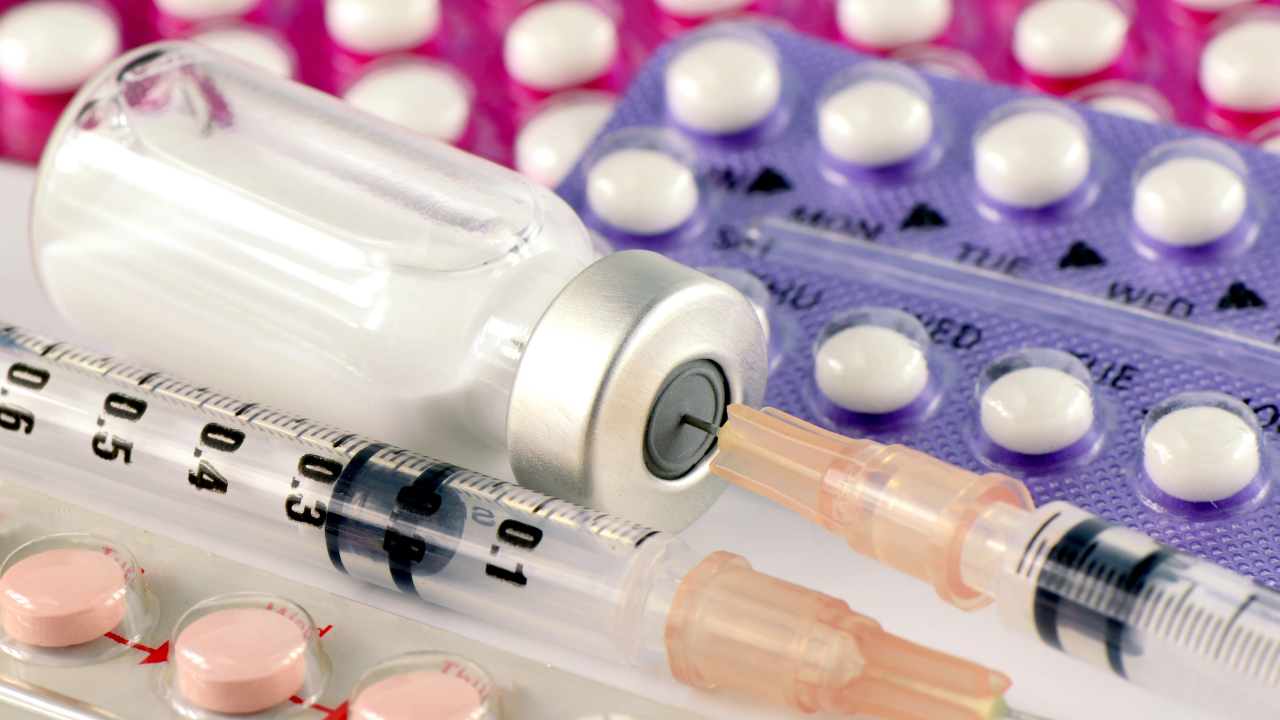
Perimenopausal women on hormonal contraception represent one of the most clinically nuanced patient populations in hormone optimization practice. They present with significant hormonal symptoms - fatigue, low libido, mood changes, sleep disruption, brain fog - while simultaneously being on medications that suppress, alter, and mask the very hormone levels you are trying to assess and optimize. Managing this overlap requires a clear understanding of how hormonal contraception affects endogenous hormone production, lab interpretation, and BHRT outcomes - and a practical framework for navigating the clinical decisions that arise when a patient needs both contraception and hormone optimization.
HOW HORMONAL CONTRACEPTION AFFECTS ENDOGENOUS HORMONE PRODUCTION
Combined hormonal contraceptives - pills, patches, and rings containing both estrogen and progestin - work primarily by suppressing the hypothalamic-pituitary-ovarian axis. They inhibit GnRH pulsatility, suppress LH and FSH secretion, and prevent ovulation. The clinical consequence of this suppression is that endogenous production of estradiol, progesterone, and testosterone by the ovaries is significantly reduced or effectively eliminated in most users.
This means that a hormone panel drawn on a patient using combined hormonal contraception does not reflect her natural endogenous hormone status. The estradiol level reflects the exogenous estrogen component of her contraceptive plus whatever minimal endogenous production remains. The testosterone level reflects suppressed ovarian production in the context of significantly elevated SHBG. And progesterone will be essentially undetectable because ovulation - the primary driver of progesterone production - has been suppressed.
Providers who order a hormone panel on a patient on combined oral contraceptives and attempt to use those values to guide BHRT dosing are making clinical decisions based on a hormonally suppressed baseline that does not represent the patient's underlying hormonal physiology. This is one of the most common sources of clinical confusion in managing this patient population and one of the most important issues to address at the first visit.
THE SHBG PROBLEM
Sex hormone-binding globulin elevation is the hormonal contraception effect that has the most direct and clinically significant impact on BHRT outcomes - particularly for testosterone therapy in women.
Estrogen-containing contraceptives strongly stimulate hepatic SHBG production. SHBG levels in women on combined oral contraceptives are typically two to four times higher than in women not using hormonal contraception. Since SHBG binds testosterone with high affinity, this elevation dramatically reduces the free fraction of testosterone - the biologically active portion that produces the clinical effects patients are seeking.
The clinical consequence is a patient who presents with classic low testosterone symptoms - low libido, fatigue, difficulty with arousal, decreased motivation, cognitive slowing - despite having a total testosterone level that may appear within the standard female reference range. The total testosterone looks adequate. The free testosterone is effectively depleted by the elevated SHBG. And the patient feels terrible.
Providers who add testosterone supplementation to a patient with significantly elevated SHBG from combined oral contraceptive use frequently encounter a frustrating clinical scenario — the testosterone dose required to produce meaningful free testosterone levels in the context of high SHBG is substantially higher than what would be needed in a patient with normal SHBG. The practical options are to address the SHBG elevation by changing or discontinuing the estrogen-containing contraceptive, to use the free testosterone level rather than total testosterone to guide dosing decisions, or to accept that testosterone optimization will be incomplete while the patient remains on combined hormonal contraception.
INTERPRETING LABS ACCURATELY IN PATIENTS ON HORMONAL CONTRACEPTION
Given the hormonal suppression and SHBG elevation associated with combined hormonal contraceptives, lab interpretation in these patients requires specific adjustments to standard hormone panel interpretation.
For patients on combined oral contraceptives, the following interpretive adjustments apply. Total testosterone levels will appear falsely low due to SHBG elevation - free testosterone is the more clinically relevant value. Estradiol levels reflect the exogenous estrogen component and cannot be used to assess endogenous estrogen status. LH and FSH will be suppressed and do not provide useful information about ovarian reserve or menopausal status in this context. Progesterone will be low to undetectable in the absence of ovulation.
For patients on progestin-only contraceptives - the mini-pill, hormonal IUD, or implant - the hormonal suppression is less complete. Ovulation may be partially maintained with some progestin-only methods, and endogenous estradiol production may be less suppressed. However, progestin-only methods still affect the hormonal environment and should be noted when interpreting hormone panels.
The most reliable approach for patients on combined hormonal contraception who want a meaningful baseline hormone assessment is to discontinue the contraceptive for a minimum of four to eight weeks before drawing baseline labs - ideally with a reliable non-hormonal contraceptive method in place during that interval. This allows SHBG to normalize and endogenous hormone production to resume, producing lab values that accurately reflect the patient's underlying hormonal status.
BHRT IN PATIENTS WHO REMAIN ON HORMONAL CONTRACEPTION
Some patients are not willing or able to discontinue their hormonal contraception before initiating BHRT - and for these patients, a practical clinical approach is needed.
Testosterone therapy in patients on combined oral contraceptives. Testosterone can be added to a patient on combined hormonal contraception, but providers should anticipate the need for higher doses due to SHBG elevation, should use free testosterone rather than total testosterone to guide dosing, and should counsel the patient that the clinical response may be less robust than it would be in the absence of SHBG elevation. Documenting the SHBG level and its impact on free testosterone in the chart note provides important clinical context for the dosing decision.
Progesterone in patients on combined oral contraceptives. Adding bioidentical progesterone to a patient already on a progestin-containing contraceptive requires careful consideration. The progestin component of combined oral contraceptives acts on progesterone receptors but is not identical to bioidentical progesterone in its receptor binding profile or downstream effects. Some providers add oral micronized progesterone at bedtime for its neurosteroid sleep and anxiolytic effects even in patients on combined oral contraceptives, reasoning that the neurologic indication is distinct from the contraceptive progestin's primary mechanism. This is a clinically reasonable approach when the neurologic indication is clear and the patient is appropriately counseled.
Estradiol supplementation in patients on combined oral contraceptives is generally not indicated - the patient is already receiving exogenous estrogen from her contraceptive. Adding bioidentical estradiol in this context risks supraphysiologic estrogen levels without meaningful clinical benefit.
THE PERIMENOPAUSAL PATIENT WHO NEEDS BOTH
One of the most common and most practically challenging scenarios in hormone optimization practice is the perimenopausal patient who presents with significant hormonal symptoms and still needs reliable contraception. She is not yet menopausal - she may still be ovulating intermittently - but she is experiencing enough hormonal disruption to significantly affect her quality of life.
This patient has several clinical options that providers should be familiar with and able to discuss.
Continue combined oral contraceptives with acceptance of incomplete hormone optimization. Some patients prefer to remain on combined hormonal contraception for the convenience and the reliable cycle control it provides, accepting that testosterone optimization will be limited by SHBG elevation. This is a reasonable choice for patients who are several years from menopause and for whom contraception is a higher priority than maximum hormone optimization.
Transition to a progestin-only or non-hormonal contraceptive method with addition of BHRT. Switching from a combined oral contraceptive to a hormonal IUD, progestin-only implant, or copper IUD allows for significant reduction in SHBG - particularly if the switch is to a non-estrogen-containing method - while maintaining reliable contraception. BHRT can then be titrated against a more meaningful hormone baseline. This is the approach that typically produces the best hormone optimization outcomes while maintaining contraceptive efficacy.
Use the hormonal IUD as both the uterine protection component of BHRT and the contraceptive. A patient on systemic estradiol and testosterone BHRT who uses a hormonal IUD benefits from the IUD's local progestin effect for uterine protection - though providers should be aware that the levonorgestrel from a hormonal IUD does not provide the neurosteroid benefits of oral micronized progesterone and that the two are not interchangeable for all clinical indications.
SIMPLIFYING THE CONVERSATION WITH PATIENTS
The clinical complexity of managing hormonal contraception and BHRT simultaneously can feel overwhelming to communicate to patients. The following framing simplifies the key points without sacrificing accuracy.
Explain that their contraceptive is affecting their hormone levels in ways that make it harder to get the full benefit of hormone optimization. Use the analogy of trying to fill a bucket that has a drain - adding hormones while SHBG is significantly elevated is less efficient than addressing the SHBG issue first. Offer a clear transition plan if the patient is open to changing her contraceptive method, and explain what the clinical benefits of that transition are likely to be. For patients who prefer to remain on combined hormonal contraception, be honest about the limitations - acknowledge that hormone optimization will be partial rather than complete, explain why, and document that the patient understands this.
BOTTOM LINE
Hormonal contraception and BHRT interact in clinically significant ways that affect lab interpretation, testosterone response, and overall hormone optimization outcomes. Providers who understand the SHBG elevation mechanism, who adjust their lab interpretation accordingly, and who have a practical framework for navigating the transition from contraception to hormone optimization consistently achieve better clinical outcomes in perimenopausal patients than those who manage the two clinical areas in isolation.