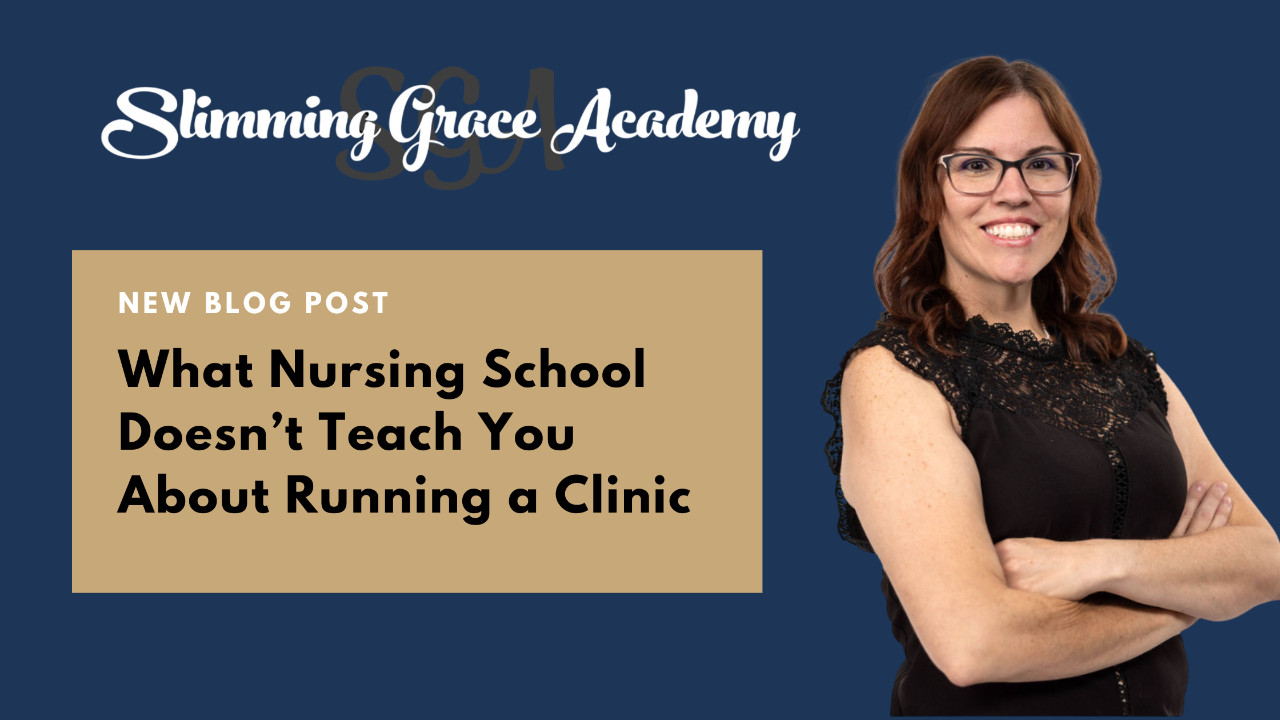
What Nursing School Doesn’t Teach You About Running a Clinic
Jul 15, 2026Becoming a healthcare provider takes years of education, training, sacrifice, and clinical experience. Nursing school teaches providers how to assess patients, understand disease processes, create treatment plans, and deliver quality care.
But what many providers quickly discover after entering the real world is this:
Running a clinic requires an entirely different skill set.
At Slimming Grace Academy, we work with providers who are incredibly capable clinically — but often feel overwhelmed by the operational, emotional, and leadership responsibilities that come with owning or managing a healthcare practice.
Because the truth is, nursing school teaches medicine. It does not always teach the realities of running a business, leading a team, managing risk, or navigating the pressure that comes with making decisions that impact both patients and a practice.
And those lessons are often learned the hard way.
The Reality of Clinic Ownership Is Different Than Most Providers Expect
Many providers enter healthcare because they genuinely want to help people.
They want to care for patients, improve lives, and make a difference in their communities.
What they are often unprepared for is everything happening behind the scenes.
Running a clinic means constantly balancing:
- patient care,
- documentation,
- compliance,
- staffing,
- scheduling,
- finances,
- operational systems,
- patient communication,
- marketing,
- leadership,
- and emotional responsibility.
Even highly experienced providers can feel overwhelmed trying to manage all of those moving parts at once.
In many ways, providers are expected to become healthcare professionals, business owners, managers, compliance officers, and leaders simultaneously — often without formal preparation in those areas.
Textbook Medicine Does Not Always Prepare You for Real Patients
In school, many scenarios are presented in ideal conditions with straightforward treatment pathways and textbook answers.
But real life rarely works that way.
Real patients have:
- different lifestyles,
- financial limitations,
- emotional stress,
- inconsistent routines,
- complex medical histories,
- and varying levels of support and understanding.
Providers quickly learn that healthcare is not always black and white.
A patient may know exactly what they should do but still struggle to implement it. Another patient may have symptoms that technically “don’t fit the textbook,” yet something still feels wrong.
This is where real-world provider experience becomes critical.
Medicine is not only about memorizing information. It’s about communication, judgment, adaptability, listening, and understanding the human side of care.
Documentation and Compliance Become a Full-Time Responsibility
One of the biggest surprises for many new clinic owners is the amount of time and responsibility tied to documentation and compliance.
Many providers enter independent practice thinking primarily about patient care — not realizing how important operational systems and documentation become in protecting both patients and providers.
In today’s healthcare environment, providers must be intentional about:
- charting,
- policies,
- patient communication,
- informed consent,
- medication management,
- and operational consistency.
Small mistakes can quickly create larger problems if systems are not in place.
That’s why provider education needs to extend beyond medicine itself.
Understanding how to run a safe, organized, patient-centered clinic is just as important as understanding clinical treatment plans.
Leadership Is One of the Hardest Parts of Running a Clinic
Managing people is something very few providers are formally trained to do.
But once a clinic begins growing, leadership becomes one of the most important parts of the business.
Providers often find themselves responsible for:
- hiring,
- training,
- culture,
- accountability,
- communication,
- and problem-solving within their teams.
And unlike clinical medicine, there is rarely a textbook answer for leadership challenges.
Strong clinics require strong systems, healthy communication, and intentional leadership — all while maintaining quality patient care.
That responsibility can feel extremely heavy for providers trying to do everything themselves.
Provider Burnout Is Real
Many clinic owners silently carry enormous pressure.
Patients depend on them.
Employees depend on them.
Their families depend on them.
And in many cases, their entire business depends on them making the right decisions every single day.
That level of responsibility can become emotionally exhausting.
Unfortunately, many providers feel isolated in those experiences because healthcare culture often encourages people to “push through” instead of asking for support.
At Slimming Grace Academy, we believe providers deserve education, mentorship, and practical conversations about the emotional realities of healthcare leadership and clinic ownership — not just clinical training.
Because providers need support too.
Real-World Provider Education Matters
Healthcare is changing quickly.
Modern providers are expected to understand:
- patient care,
- operations,
- leadership,
- compliance,
- communication,
- technology,
- and business management all at once.
That’s why real-world provider education is so important.
At Slimming Grace Academy, our mission is to help bridge the gap between traditional education and real-world clinical practice by providing practical, experience-driven education for modern healthcare providers.
Because the reality is:
Some of the most important lessons in healthcare are never taught in a classroom.
And the more prepared providers are, the better they can care for both their patients and themselves.
To learn more about real-world provider education and practical clinical training, visit:
https://academy.slimminggrace.com/
Don't miss a beat!
New moves, motivation, and classes delivered to your inbox.
We hate SPAM. We will never sell your information, for any reason.