
You Know the Medicine. But Do You Know What to Do Next?


You made it through school. You studied the diseases, learned the medications, memorized the guidelines, and worked hard to become a provider.
Then you entered primary care.
And suddenly, everything felt different.
Because knowing the information is one thing.
Knowing what to do when an actual patient is sitting in front of you is another.
I created The Real-World Provider to help close that gap.
To take the knowledge you already have and help you apply it to the patients you actually see.
Because primary care isn't just about knowing the diagnosis.
It's about knowing what to ask, what to order, what to consider, what to treat, what to document, and what to do next.

You Know the Medicine. But Do You Know What to Do Next?
You made it through school. You studied the diseases, learned the medications, memorized the guidelines, and worked hard to become a provider.
Then you entered primary care.
And suddenly, everything felt different.
Because knowing the information is one thing.
Knowing what to do when an actual patient is sitting in front of you is another.
I created The Real-World Provider to help close that gap.
To take the knowledge you already have and help you apply it to the patients you actually see.
Because primary care isn't just about knowing the diagnosis.
It's about knowing what to ask, what to order, what to consider, what to treat, what to document, and what to do next.


Welcome!
Primary care asks you to know a little about a lot - and then make sound clinical decisions in a limited amount of time.
That's exactly why The Real-World Provider: Primary Care Masterclass exists.


You Know That Feeling...
→ When a patient presents with a complaint and you know something isn't quite right, but you're trying to figure out where to start.
→ When the lab results come back and you're asking yourself, "What does this actually mean for my patient?"
→ When you're deciding whether you need more testing, treatment, imaging, follow-up, or a referral.
→ When you know the condition but still find yourself wondering, "What would I actually do if this patient walked into my clinic today?"
I've been there. And that's the gap this course was created to help address.

......
You didn't spend years learning medicine just to feel like you're piecing everything together once you're finally in the exam room.
You learned the knowledge.
You learned the science.
But no one always teaches you how to bring all of those pieces together when the patient is sitting right in front of you.
It's the difference between knowing medicine and practicing medicine.
But here's what's really happening:
Primary care isn't difficult simply because there is so much to know
- it's difficult because you're expected to connect the information and make decisions in real time.
A patient's chief complaint is rarely the whole story
- you have to know what questions to ask, what findings matter, and what possibilities you shouldn't overlook.
Knowing the guideline isn't always enough
- you still need to determine how that information applies to the individual patient in front of you.
The confidence comes from having a clinical framework
- when you know how to approach the patient, the next step becomes much clearer.

The clinical knowledge? You've got that.
The real-world clinical application? That's where many providers need more support.
And "I know the information" doesn't always mean "I know exactly what to do next."
Welcome!
Primary care asks you to know a little about a lot - and then make sound clinical decisions in a limited amount of time.
That's exactly why The Real-World Provider: Primary Care Masterclass exists.

You Know That Feeling...
→ When a patient presents with a complaint and you know something isn't quite right, but you're trying to figure out where to start.
→ When the lab results come back and you're asking yourself, "What does this actually mean for my patient?"
→ When you're deciding whether you need more testing, treatment, imaging, follow-up, or a referral.
→ When you know the condition but still find yourself wondering, "What would I actually do if this patient walked into my clinic today?"
I've been there. And that's the gap this course was created to help address.
......
You didn't spend years learning medicine just to feel like you're piecing everything together once you're finally in the exam room.
You learned the knowledge.
You learned the science.
But no one always teaches you how to bring all of those pieces together when the patient is sitting right in front of you.
It's the difference between knowing medicine and practicing medicine.
But here's what's really happening:
Primary care isn't difficult simply because there is so much to know
- it's difficult because you're expected to connect the information and make decisions in real time.
A patient's chief complaint is rarely the whole story
- you have to know what questions to ask, what findings matter, and what possibilities you shouldn't overlook.
Knowing the guideline isn't always enough
- you still need to determine how that information applies to the individual patient in front of you.
The confidence comes from having a clinical framework
- when you know how to approach the patient, the next step becomes much clearer.

The clinical knowledge? You've got that.
The real-world clinical application? That's where many providers need more support.
And "I know the information" doesn't always mean "I know exactly what to do next."
What If You Could Walk Into Primary Care With Confidence?
Picture this...
✓ A patient walks in with a common complaint - and you know where to begin.
✓ You know which questions to ask and which findings deserve your attention.
✓ You can build a focused differential instead of trying to consider everything at once.
✓ You understand when laboratory testing is appropriate and how to interpret the results in context.
✓ You can work through treatment options and determine what comes next.
✓ You recognize red flags that require additional evaluation or referral.
✓ You know what follow-up the patient needs.
✓ You can document your clinical reasoning more intentionally.
✓ You have practical resources you can return to when you need a refresher.
That's not just a dream. It's what happens when you stop trying to memorize everything and start developing a practical way to approach the patient in front of you.
ENROLL IN DIABETES DECODED NOWWhat If You Could Walk Into Primary Care With Confidence?
Picture this...
✓ A patient walks in with a common complaint - and you know where to begin.
✓ You know which questions to ask and which findings deserve your attention.
✓ You can build a focused differential instead of trying to consider everything at once.
✓ You understand when laboratory testing is appropriate and how to interpret the results in context.
✓ You can work through treatment options and determine what comes next.
✓ You recognize red flags that require additional evaluation or referral.
✓ You know what follow-up the patient needs.
✓ You can document your clinical reasoning more intentionally.
✓ You have practical resources you can return to when you need a refresher.
That's not just a dream. It's what happens when you stop trying to memorize everything and start developing a practical way to approach the patient in front of you.
Protect My Practice NowI Built This for the Provider Who Wants to Know What to Do Next
I'm Richard Hernandez, FNP, and I created The Real-World Provider because I know that becoming a provider doesn't end when you finish school.
You can learn the conditions, study the medications, understand the guidelines, and build a strong clinical foundation. But once you're in the exam room, you're faced with something different: a patient with a story, multiple concerns, incomplete information, and a decision that needs to be made.
And that's where the gap between knowing the medicine and applying it in practice can become very real.
Primary care requires you to bring everything together—your clinical knowledge, your judgment, your assessment skills, and your ability to make decisions in real time.
I wanted to create something that helps providers feel more prepared for those moments.
Something that focuses not just on what a condition is, but on how to think through the patient, what to consider, and what comes next.
So I created The Real-World Provider to help providers take what they already know and apply it with greater confidence.




I Built This for the Provider Who Wants to Know What to Do Next
I'm Richard Hernandez, FNP, and I created The Real-World Provider because I know that becoming a provider doesn't end when you finish school.
You can learn the conditions, study the medications, understand the guidelines, and build a strong clinical foundation. But once you're in the exam room, you're faced with something different: a patient with a story, multiple concerns, incomplete information, and a decision that needs to be made.
And that's where the gap between knowing the medicine and applying it in practice can become very real.
Primary care requires you to bring everything together - your clinical knowledge, your judgment, your assessment skills, and your ability to make decisions in real time.
I wanted to create something that helps providers feel more prepared for those moments.
Something that focuses not just on what a condition is, but on how to think through the patient, what to consider, and what comes next.
So I created The Real-World Provider to help providers take what they already know and apply it with greater confidence.
This isn't another generic course. It's a practical resource designed to help you work through common primary-care situations, understand what comes next, and feel more prepared for the patient in front of you.
This is about turning knowledge into practice.
ENROLL IN DIABETES DECODED NOWThis isn't another generic course. It's a practical resource designed to help you work through common primary-care situations, understand what comes next, and feel more prepared for the patient in front of you.
This is about turning knowledge into practice.
Protect My Practice Now
This Is For You If...
✓ You're a new NP or PA entering primary care.
✓ You're a physician transitioning into primary care.
✓ You're returning to primary care after working in another specialty.
✓ You're an experienced provider who wants to refresh your primary-care knowledge.
✓ You want a more practical approach to common patient presentations.
✓ You want to strengthen your clinical reasoning and decision-making.
✓ You want to become more comfortable interpreting common laboratory results.
✓ You want to improve how you approach diagnosis, treatment, and follow-up.
✓ You want to strengthen your primary-care workflow and documentation.
✓ You want practical clinical resources you can return to as you continue practicing.
This Is Not For You If...
✗ You're looking for a board-exam review course.
✗ You're looking for a replacement for formal clinical training or supervised practice.
✗ You're looking for specialty-level training in one specific area of medicine.
✗ You're looking for treatment decisions without considering the individual patient.
✗ You're looking for a substitute for current clinical guidelines or professional judgment.
✗ You expect one course to cover every possible condition you may encounter in practice.
This Is For You If...
✓ You're a new NP or PA entering primary care.
✓ You're a physician transitioning into primary care.
✓ You're returning to primary care after working in another specialty.
✓ You're an experienced provider who wants to refresh your primary-care knowledge.
✓ You want a more practical approach to common patient presentations.
✓ You want to strengthen your clinical reasoning and decision-making.
✓ You want to become more comfortable interpreting common laboratory results.
✓ You want to improve how you approach diagnosis, treatment, and follow-up.
✓ You want to strengthen your primary-care workflow and documentation.
✓ You want practical clinical resources you can return to as you continue practicing.
This Is Not For You If...
✗ You're looking for a board-exam review course.
✗ You're looking for a replacement for formal clinical training or supervised practice.
✗ You're looking for specialty-level training in one specific area of medicine.
✗ You're looking for treatment decisions without considering the individual patient.
✗ You're looking for a substitute for current clinical guidelines or professional judgment.
✗ You expect one course to cover every possible condition you may encounter in practice.
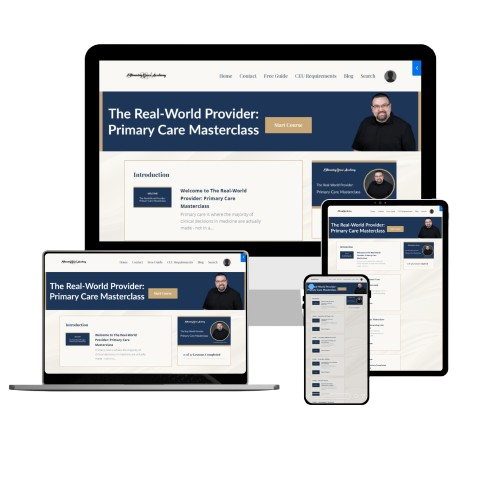
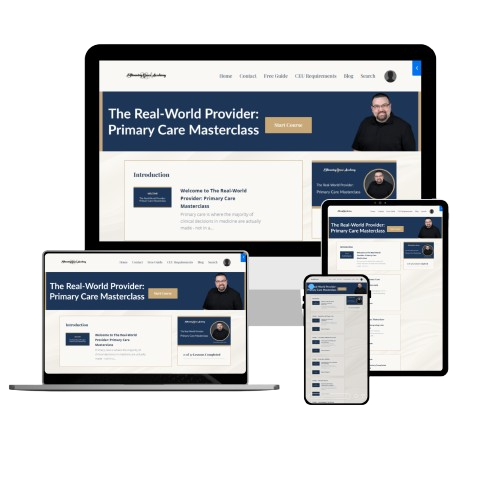
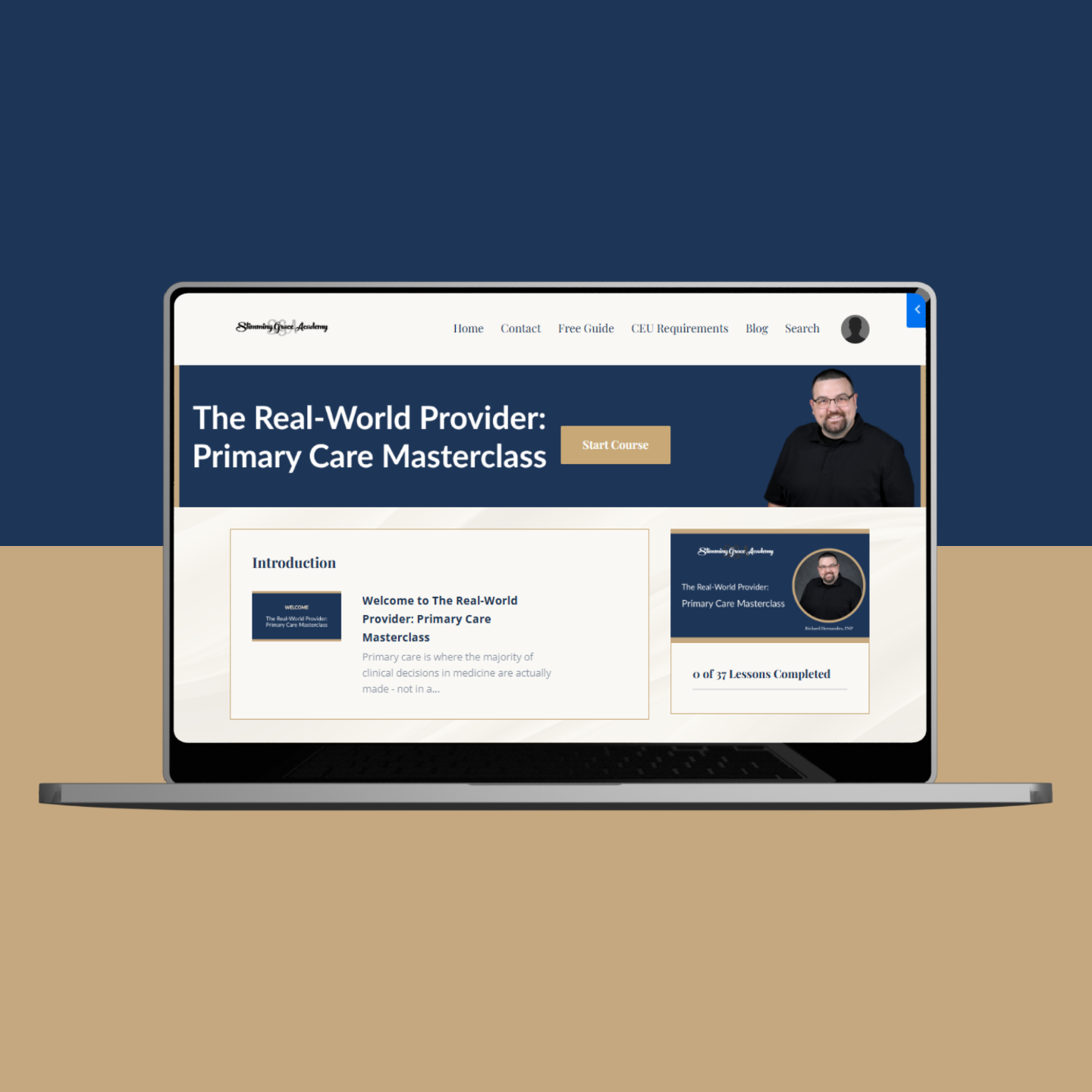
When you enroll in The Real-World Provider: Primary Care Masterclass, you get access to a comprehensive primary-care learning system designed to help you connect clinical knowledge with practical patient care.

The Real-World Provider Course System
The complete self-paced masterclass covering 18 modules across the major areas of primary care—from foundational practice and laboratory medicine to cardiology, endocrinology, women's health, pediatrics, geriatrics, preventive care, office procedures, and provider protection.

Practical Resources
Access supporting clinical resources designed to reinforce the concepts covered throughout the masterclass and give you useful references as you continue developing your practice.

Lifetime Access
Work through the course at your own pace and return to the lessons and materials whenever you need them.
The Real-World Provider Course System
The complete self-paced masterclass covering 18 modules across the major areas of primary care - from foundational practice and laboratory medicine to cardiology, endocrinology, women's health, pediatrics, geriatrics, preventive care, office procedures, and provider protection.
Practical Resources
Access supporting clinical resources designed to reinforce the concepts covered throughout the masterclass and give you useful references as you continue developing your practice.
Lifetime Access
Work through the course at your own pace and return to the lessons and materials whenever you need them.
What's Inside The Real-World Provider
Module 1
Foundations of Primary Care
Build your foundation with common visit types, primary-care workflow, preventive care, chronic disease management, documentation, time management, and recognizing situations that require emergency care.
Module 2
Laboratory Medicine Masterclass
Learn a practical approach to ordering, interpreting, and following up on common laboratory tests and applying results to the patient's clinical presentation.
Module 3
Respiratory Medicine
Work through asthma, COPD, cough, pneumonia, respiratory infections, allergic conditions, pulmonary function testing, sleep apnea, and smoking cessation.
Module 4
Infectious Disease
Develop a practical approach to common infections, cultures, antibiotic selection, and responsible antibiotic use.
Module 5
Endocrinology & Metabolism
Explore obesity, prediabetes, type 2 diabetes, thyroid conditions, lipid disorders, PCOS, nutritional deficiencies, and osteoporosis.
Module 6
Cardiology
Cover hypertension, resistant hypertension, orthostatic symptoms, chest pain, heart failure, atrial fibrillation, anticoagulation, ASCVD prevention, and lipid management.
Module 7
Gastroenterology
Learn how to approach GERD, IBS, constipation, diarrhea, MASLD, abnormal liver tests, H. pylori, and gallbladder concerns.
Module 8
Women's Health
Review preventive screening, menopause, vaginitis, abnormal uterine bleeding, contraception, and urinary concerns.
Module 9
Men's Health
Explore testosterone evaluation, erectile dysfunction, BPH, PSA considerations, and basic infertility evaluation.
Module 10
Neurology
Develop a practical approach to headaches, migraines, neuropathy, vertigo, memory concerns, and recognizing possible TIA or stroke.
Module 11
Musculoskeletal
Work through common concerns including sciatica, low back pain, knee and shoulder problems, osteoarthritis, fibromyalgia, and gout.
Module 12
Dermatology
Explore acne, rosacea, psoriasis, eczema, undifferentiated rashes, hair loss, and skin cancer screening.
Module 13
Mental Health
Cover anxiety, depression, ADHD, insomnia, panic symptoms, burnout, and substance-use screening in the primary-care setting.
Module 14
Pediatrics
Review foundational pediatric care including well-child visits, common childhood infections, childhood obesity, and ADHD.
Module 15
Geriatrics
Develop a practical approach to falls, polypharmacy, dementia screening, frailty, and advance care planning
Module 16
Office Procedures
Review common office-based procedures including joint injections, trigger-point injections, skin biopsy, cryotherapy, incision and drainage, toenail removal, ear irrigation, and laceration repair.
Module 17
Preventive Care & Screening
Cover cancer screening, bone health, cardiovascular prevention, immunizations, infectious disease screening, depression screening, and Medicare wellness visits.
Module 18
Provider Protection & Practice Survival
Strengthen your understanding of documentation, medical decision-making, informed consent, SOPs, standing orders, delegation, incident reporting, medication safety, chart audits, risk management, malpractice prevention, board investigations, and employment considerations.
....
A Complete Primary Care Foundation
Instead of jumping from one isolated topic to another, you'll work through 18 areas of primary care designed to help you develop a broader clinical framework.
What's Inside The Real-World Provider
Module 1
Foundations of Primary Care
Build your foundation with common visit types, primary-care workflow, preventive care, chronic disease management, documentation, time management, and recognizing situations that require emergency care.
Module 2
Laboratory Medicine Masterclass
Learn a practical approach to ordering, interpreting, and following up on common laboratory tests and applying results to the patient's clinical presentation.
Module 3
Respiratory Medicine
Work through asthma, COPD, cough, pneumonia, respiratory infections, allergic conditions, pulmonary function testing, sleep apnea, and smoking cessation.
Module 4
Infectious Disease
Endogenous insulin secretion, basal vs bolus function, timing, onset, peak, duration, and why stacking insulin causes hypoglycemia. Insulin is not strong - it is specific.
Module 5
Endocrinology & Metabolism
Explore obesity, prediabetes, type 2 diabetes, thyroid conditions, lipid disorders, PCOS, nutritional deficiencies, and osteoporosis.
Module 6
Cardiology
Cover hypertension, resistant hypertension, orthostatic symptoms, chest pain, heart failure, atrial fibrillation, anticoagulation, ASCVD prevention, and lipid management.
Module 7
Gastroenterology
Learn how to approach GERD, IBS, constipation, diarrhea, MASLD, abnormal liver tests, H. pylori, and gallbladder concerns.
Module 8
Women's Health
Review preventive screening, menopause, vaginitis, abnormal uterine bleeding, contraception, and urinary concerns.
Module 9
Men's Health
Explore testosterone evaluation, erectile dysfunction, BPH, PSA considerations, and basic infertility evaluation.
Module 10
Neurology
Develop a practical approach to headaches, migraines, neuropathy, vertigo, memory concerns, and recognizing possible TIA or stroke.
Module 11
Musculoskeletal
Work through common concerns including sciatica, low back pain, knee and shoulder problems, osteoarthritis, fibromyalgia, and gout.
Module 12
Dermatology
Explore acne, rosacea, psoriasis, eczema, undifferentiated rashes, hair loss, and skin cancer screening.
Module 13
Mental Health
Cover anxiety, depression, ADHD, insomnia, panic symptoms, burnout, and substance-use screening in the primary-care setting.
Module 14
Pediatrics
Review foundational pediatric care including well-child visits, common childhood infections, childhood obesity, and ADHD.
Module 15
Geriatrics
Develop a practical approach to falls, polypharmacy, dementia screening, frailty, and advance care planning.
Module 16
Office Procedures
Review common office-based procedures including joint injections, trigger-point injections, skin biopsy, cryotherapy, incision and drainage, toenail removal, ear irrigation, and laceration repair.
Module 17
Preventive Care & Screening
Cover cancer screening, bone health, cardiovascular prevention, immunizations, infectious disease screening, depression screening, and Medicare wellness visits.
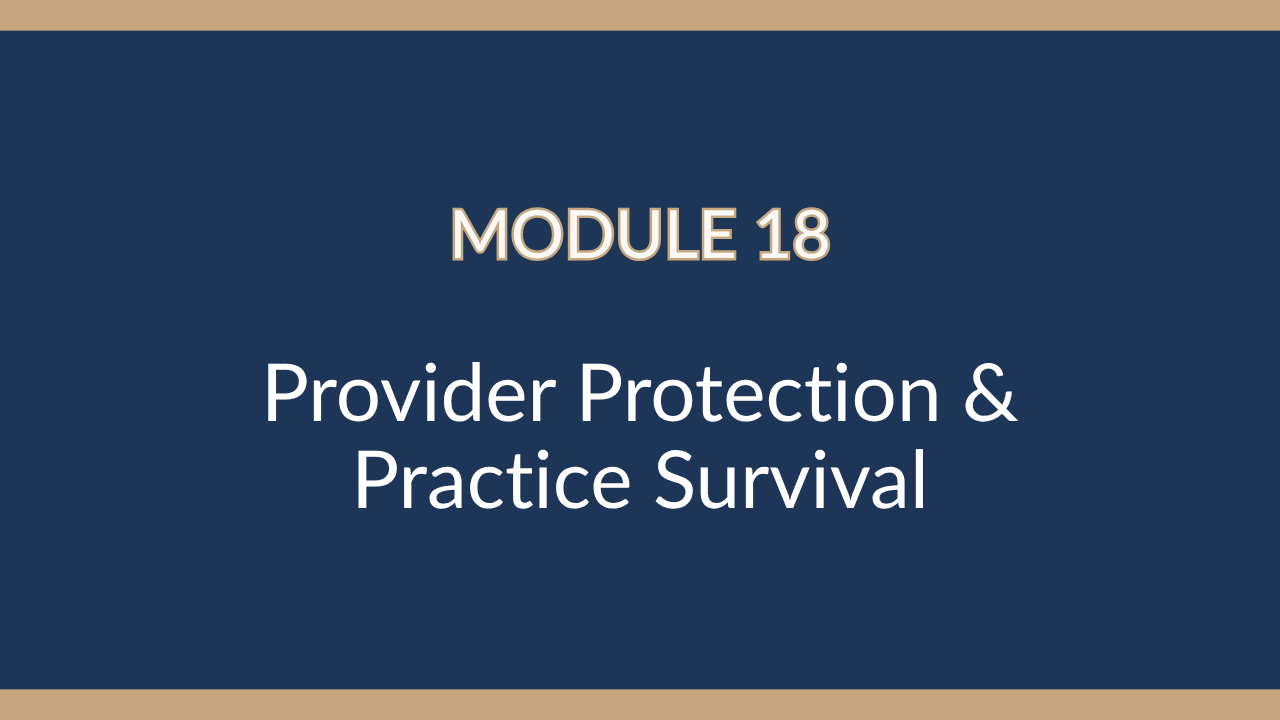
Module 18
Provider Protection & Practice Survival
Strengthen your understanding of documentation, medical decision-making, informed consent, SOPs, standing orders, delegation, incident reporting, medication safety, chart audits, risk management, malpractice prevention, board investigations, and employment considerations.
....
A Complete Primary Care Foundation
Instead of jumping from one isolated topic to another, you'll work through 18 areas of primary care designed to help you develop a broader clinical framework.
When you add it all up:
➞ The Real-World Provider Course System: ($_____ Value)
➞ The Real-World Provider Resource Library: ($_____ Value)
➞ 18 Comprehensive Primary Care Modules: ($_____ Value)
Total Value: $_____
Your Investment Today:
Just $____
ENROLL NOW
When you add it all up:
➞ The Real-World Provider Course System: ($_____ Value)
➞ The Real-World Provider Resource Library: ($_____ Value)
➞ 18 Comprehensive Primary Care Modules: ($_____ Value)
Total Value: $_____
Your Investment Today:
Just $_____
ENROLL NOW
By the end of this course, you will:
→ Have a stronger framework for approaching common primary-care visits.
→ Know how to move from the patient's chief complaint toward a focused clinical plan.
→ Strengthen your approach to history-taking, physical examination, and differential diagnosis.
→ Better understand common laboratory testing and how results fit into the clinical picture.
→ Develop a more practical approach to treatment and follow-up.
→ Recognize important red flags and situations that may require referral.
→ Strengthen your approach to preventive care and screening.
→ Build greater familiarity with common office procedures.
→ Improve your clinical documentation and clinical decision-making process.
→ Have practical resources you can return to as you continue learning.
→ Feel more prepared to answer the question: "What do I do next?"
ENROLL NOW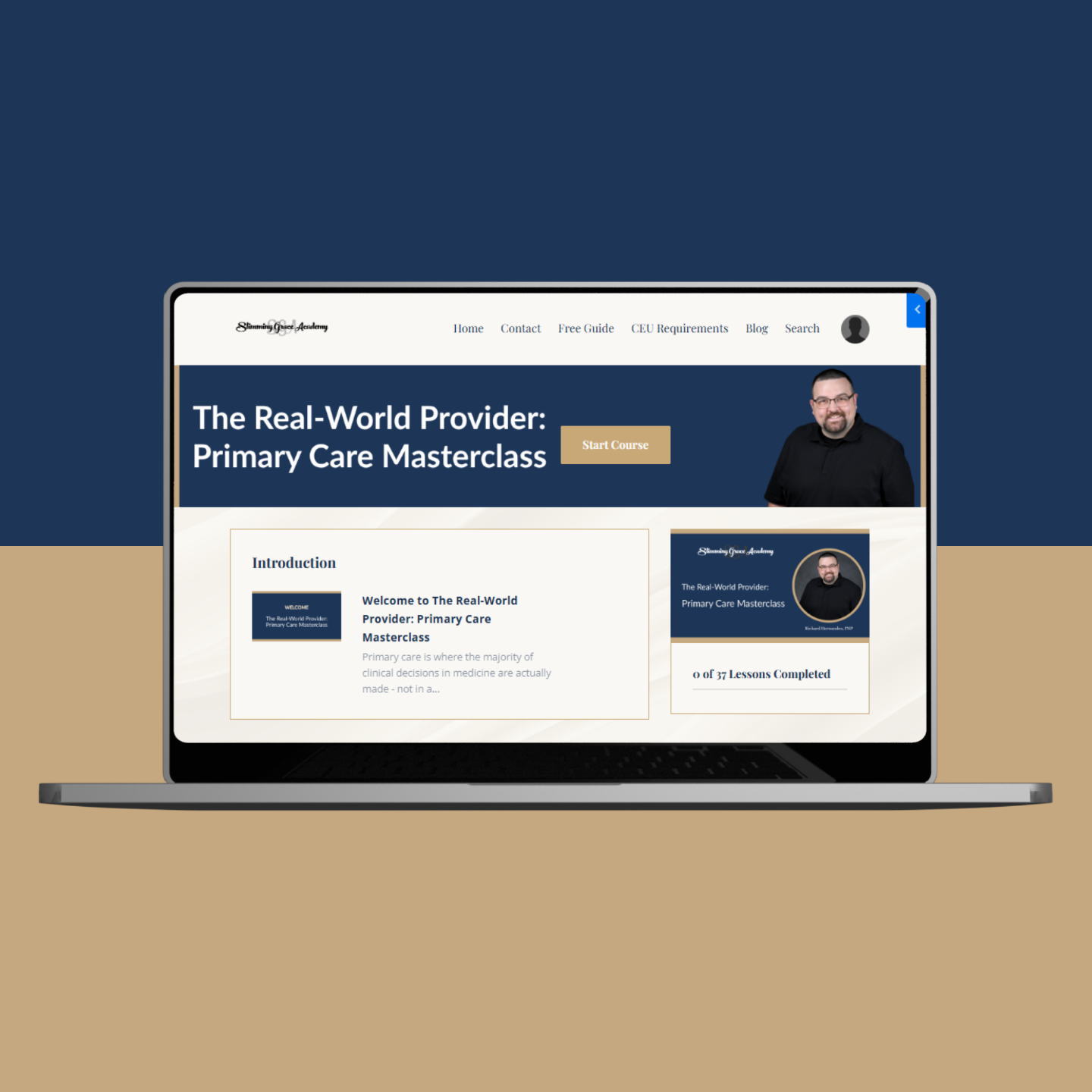
By the end of this course, you will:
→ Have a stronger framework for approaching common primary-care visits.
→ Know how to move from the patient's chief complaint toward a focused clinical plan.
→ Strengthen your approach to history-taking, physical examination, and differential diagnosis.
→ Better understand common laboratory testing and how results fit into the clinical picture.
→ Develop a more practical approach to treatment and follow-up.
→ Recognize important red flags and situations that may require referral.
→ Strengthen your approach to preventive care and screening.
→ Build greater familiarity with common office procedures.
→ Improve your clinical documentation and clinical decision-making process.
→ Have practical resources you can return to as you continue learning.
→ Feel more prepared to answer the question: "What do I do next?"
ENROLL NOW
Our "Practice with Confidence" Guarantee
I stand behind this course completely and want you to feel 100% secure in your investment.
Enroll today and put the strategies to the test. If you don't feel more prepared and confident in your ability to protect your license, I haven't done my job.
Just reach out within 30 days for a refund as per our policy terms. You can start building a safer practice today, completely risk-free.
Our "Practice with Confidence" Guarantee
I stand behind this course completely and want you to feel 100% secure in your investment.
Enroll today and put the strategies to the test. If you don't feel more prepared and confident in your ability to protect your license, I haven't done my job.
Just reach out within 30 days for a refund as per our policy terms. You can start building a safer practice today, completely risk-free.
What will I learn in this course?
You'll learn a practical approach to common primary-care conditions and patient presentations, including assessment, differential diagnosis, laboratory interpretation, treatment, follow-up, preventive care, and when to refer.
How do I access my course after purchase?
Once you enroll, you'll receive access to The Real-World Provider through the online learning platform. You can log in and begin the course at your convenience.
Do I need to complete the course in a certain amount of time?
No. You'll have lifetime access, so you can work through the course at your own pace without an expiration date.
What if I have questions during the course?
If you have questions about the course content or need assistance while completing the program, please email us at danni@slimminggrace.com.
Don't Let Clinical Uncertainty Cost Your Patient - or Your Confidence
Every patient you see deserves a provider who knows how to approach the situation with clarity and confidence.
Every clinical decision made without a clear framework is an opportunity to miss something important.
Every documentation gap or missed follow-up can create unnecessary risk for both you and your patient.
The time to build your clinical confidence is NOW. Before the complex patient walks through your door.
You don't have to know everything. You need to know how to approach what comes next.
ENROLL IN THE REAL-WORLD PROVIDER NOW
Don't Let Clinical Uncertainty Cost Your Patient - or Your Confidence
Every patient you see deserves a provider who knows how to approach the situation with clarity and confidence.
Every clinical decision made without a clear framework is an opportunity to miss something important.
Every documentation gap or missed follow-up can create unnecessary risk for both you and your patient.
The time to build your clinical confidence is NOW. Before the complex patient walks through your door.
You don't have to know everything. You need to know how to approach what comes next.
ENROLL IN THE REAL-WORLD PROVIDER NOW